


What suit to wear to a wedding: how to choose for your role and the season
Contents▾
- What suit to wear to a wedding, depending on your role
- The colour palette that works every time
- Fabrics and seasons: what to wear and when
- Cut and body shape: the truth that changes everything
- Shirt, tie, shoes: the details that make the difference
- What to avoid at all costs as a guest
- Two-piece or three-piece: which should you really choose?
- Budget: what to expect for your money
- Planning: how to get organised without the stress
- 2026 trends: what is really changing
- Put it into practice
“What suit to wear to a wedding?” has no single right answer. It depends on your role on the big day (groom, best man or guest), the dress code, the season and the time of the ceremony. A navy wool suit at noon in June is a world away from a charcoal three-piece in the evening. This article settles each point in turn.
At jerem.com, we have been dressing men for weddings and formal occasions for years. Three mistakes come up again and again in our shops. Head-to-toe black on a daytime guest. A cut so loose that it gapes at the back by the first “I do”. A suit bought a week before the day, with no time left to alter the trousers. A simple method helps you avoid all three.

What suit to wear to a wedding, depending on your role
Your role on the day sets the level of formality and how far you should stand apart from the groom. The groom wears the most distinguished outfit, the best man sits one notch below, and guests keep it understated, never competing for attention. This hierarchy settles 80% of style questions before colours or fabrics even come into it.
The groom: a three-piece and a signature detail
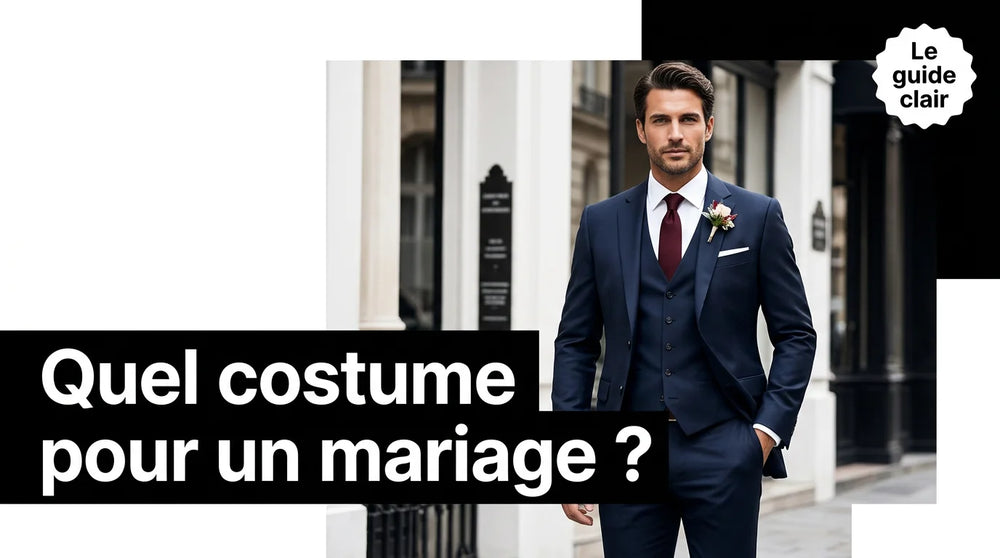
For the groom, the wedding outfit is meant to stand out without tipping into fancy dress. A three-piece in midnight-blue, charcoal-grey or deep plum wool is the benchmark. The waistcoat adds a layer of sophistication, the jacket can be worn open in the evening, and the silhouette stays sharp. One signature detail is enough: a buttonhole flower, a hand-stitched lapel, a contrasting silk pocket square or a subtly patterned tie. Bespoke and made-to-measure are worth the investment if the budget allows: they settle the fit once and for all.
The best man: close to the groom, without copying him
The best man often wears a two-piece coordinated with the couple, in a similar but distinct colour. If the groom chooses midnight blue, the best man switches to royal blue or mid-grey. A bow tie remains an option for the best man at a formal wedding; a tie is enough for everything else. A plain white shirt avoids any slip-up and leaves the flair to the accessories.
The guest: understated first, personality second
The guest aims for quiet elegance. A navy or mid-grey two-piece suit, a light-coloured shirt, a silk tie and polished leather shoes: the outfit works anywhere and takes no risks. Two rules to remember as a guest: never wear white (a colour reserved for the bride), and never wear anything too close to what the couple will be wearing, if you know it in advance. A quick call to the groom to agree on the colour palette avoids any unwelcome surprises in the photos.
The colour palette that works every time
Choosing colours happens on three levels: the suit, the shirt and the accessories. Always build from the top down and from darkest to lightest for a smart, easy-to-read look. Some colours work in every season; others only work at a specific time of year.
Navy: the safe bet all year round
Navy is the most versatile colour for a wedding suit. It flatters almost every skin tone, pairs with white, sky-blue or pale pink shirts, and takes burgundy, gold, forest-green or grey ties. It is the first suit to buy if you own only a few and have several weddings to attend in the year.
Grey: charcoal in winter, light in summer
Charcoal grey is perfect for an evening or winter ceremony; mid-grey and light grey excel at summer daytime weddings. Light grey with a white shirt and a navy tie creates a bright effect without being loud. Avoid dull mouse grey, which makes an outfit look washed out in photos.
Sky blue, forest green, plum: colours with character
A sky-blue suit works remarkably well for a country wedding in high summer. Forest green and plum suit autumn ceremonies and men who want to make a style statement. These shades call for a truly neutral shirt (white or ecru) so as not to overload the eye.
Black: save it for formal evening weddings
Contrary to popular belief, black is not the default colour for a wedding suit. It only works for a very formal evening wedding, such as black tie, or as a dinner suit. During the day, a plain black suit looks funereal and lacks warmth. Swap it for midnight blue or charcoal grey.
Fabrics and seasons: what to wear and when
A suit's fabric dictates comfort as much as style. A suit that is wrong for the season turns the day into an ordeal: sweltering in a chapel in July, or shivering at the drinks reception in February. Three families of fabric cover most situations.
Tropical wool and Super 100's/120's: the all-rounder
Tropical wool weighing around 250–280 g/m² is the most versatile fabric. It holds up well from spring to autumn, barely creases and takes alterations without a fuss. Super 100's or 120's fabrics offer a finer handle and a gentle drape for slightly dressier ceremonies. Explore our Super 100's and 120's selection to understand the real differences between the grades.
Linen, cotton, seersucker: the summer suit
For a wedding in July or August, especially outdoors, linen or a linen-wool blend makes all the difference. These fabrics breathe, let the air through and cope with the heat. Yes, they crease, but that is precisely part of their charm at a country wedding. Seersucker (puckered cotton) is still a rarity in France but works for a very relaxed seaside wedding.
Heavy worsted and flannel: the winter wedding
For a wedding between November and March, a 300 g/m² worsted wool or a flannel provides structure and warmth. Grey flannel in a three-piece suit gives a very British feel to a winter ceremony. A long wool coat on top completes the silhouette without spoiling the line of the suit.
Cut and body shape: the truth that changes everything
A well-fitted cut does more for the way you look than a €2,000 suit worn a size too big. This is where men go wrong most often, confusing “fitted” with “tight”. Two simple rules are all you need. The jacket should cover two-thirds of your seat, and your closed fists should fall just below its hem. The trousers should break once, slightly, on top of the shoe.
Athletic, square build
Broad shoulders, defined waist: a tailored cut with classic notch lapels flatters without exaggerating. Avoid very slim Italian cuts that pull across the back as soon as you raise your arm. A slightly wider lapel (7–8 cm) balances the shoulders.
Tall, slim build
Tall and slim: a regular or slightly tailored cut works better than an aggressively nipped-in one, which accentuates length. A three-piece adds structure to the torso. A standard notch lapel (6–7 cm) is the safe choice; a peak lapel suits a dinner suit.
Larger or shorter build
For a larger build, a regular cut with a fluid drape is visually slimming. A peak lapel draws the eye upwards. Avoid jackets that are too short and cut the line halfway down the seat.
For a shorter build, a slightly shorter jacket and trousers without turn-ups lengthen the leg. A 2-button jacket is still preferable to a 3-button one, which makes the figure look squat.

Shirt, tie, shoes: the details that make the difference
A well-fitting suit can be ruined by a shirt with too loose a collar or a badly chosen pair of shoes. Accessories are not an extra: they are the visible part of an outfit. Three areas deserve particular attention.
The shirt: white or sky blue, with the right collar
White never puts a foot wrong and works everywhere. Sky blue is a good alternative for a daytime ceremony. The French (semi-spread) collar is the most versatile; the Italian collar suits a wide tie knot or a bow tie.
A button-down collar is still too casual for a wedding. Check that you can slip a finger between the fastened collar and your neck: too tight, and the whole outfit looks strangled.
The tie or the bow tie
A silk or matte silk tie is the default choice. Discreet patterns (polka dots, herringbone, textured plain) for a formal wedding; freer patterns for a country wedding. A bow tie suits a very formal evening wedding, the groom, or a 1930s theme. Its width should match that of the shirt collar and of your face.
Shoes: plain leather, well polished
Shoes are an outfit's signature. Black or dark brown Oxfords, or cognac Derbies for a more relaxed wedding. Always smooth full-grain leather, never patent leather except with a dinner suit.
Polish them the day before, not that morning: the polish needs time to dry if it is to last. A brand-new pair that has never been worn is a guaranteed recipe for blisters. Wear them 2 or 3 times beforehand.
What to avoid at all costs as a guest
Some mistakes are so visible that they define the day. Here is the short list of faux pas to avoid:
- Head-to-toe white: reserved for the bride, never for a guest, even in a light-coloured suit.
- Plain black during the day: too funereal; go for navy or charcoal grey instead.
- A suit identical to the groom's: ask about the colour in advance if you are close to him.
- A suit that is too big or too tight: take it to be altered at least a week before.
- Trainers, boat shoes, square-toed shoes: off-limits unless the wedding is explicitly casual.
- A garish accessory: a neon tie, a pocket square that exactly matches the tie, a belt that doesn't go with your shoes.
Two-piece or three-piece: which should you really choose?
For guests, a two-piece is enough in 80% of cases. A three-piece (with waistcoat) adds depth and structure, and is particularly suited to the groom, the best man or a guest who wants to make a style statement. The waistcoat also lets you take off your jacket in the evening without spoiling the silhouette: a real plus when the dance floor heats up.
One word of warning: a waistcoat that is too long and peeks out below the jacket, or too short and shows the belt, ruins the whole look. Alterations are decisive here. If you wear braces with a three-piece, they stay hidden under the waistcoat: they are there to hold up the trousers, not to be seen.
Budget: what to expect for your money
Value for money plays out at three levels, and each one comes with clear trade-offs.
Between €200 and €400: entry-level ready-to-wear
At this level, you'll find two-piece suits in poly-viscose or wool blends. The drape is decent, but the fabric ages quickly and turns shiny at friction points after a few wears. Suitable for the occasional guest who will wear the suit 2–3 times a year. Budget an extra €30–60 for essential alterations.
Between €400 and €800: the real sweet spot
This is the price range where good-quality tropical wool becomes affordable, with solid finishing and a drape that lasts several seasons. A well-fitted €600 suit visibly outclasses a €1,200 suit worn straight off the peg. It is the best compromise in most cases.
Over €800: fine fabrics and bespoke
From this budget upwards, made-to-measure and bespoke come within reach. Super 100's or 120's fabrics, cupro or silk linings and hand finishing become the norm. Bespoke doesn't make you better-looking; it makes everything fit exactly as it should: every quirk of your build is corrected at the source. For a groom who will wear his suit several times afterwards, the investment is justified.
Planning: how to get organised without the stress
Rushing is the enemy of the wedding suit. Here is a countdown schedule that has proven itself with our customers.
- 90 days to go (3 months before): agree on the dress code with the couple, set your budget, have a first fitting in store or start the made-to-measure process.
- 60 days to go: sign off the suit, get measured for alterations, choose the shirt and tie.
- 30 days to go: final fitting after alterations, buy the shoes (they need breaking in), choose the accessories (pocket square, cufflinks, belt).
- 15 days to go: full try-on with the complete outfit put together. Take a photo to check the overall look.
- 7 days to go: apply a first coat of polish to the shoes, give the shirt a light press, check that everything is clean and ready.
- 1 day to go: hang up the suit and let it steam in the bathroom to relax the fibres.
A word on aftercare: a suit doesn't go in the washing machine unless it is explicitly designed to, and harsh dry cleaning damages the lining. Read our detailed method to wash a suit without ruining it before your next ceremony.
2026 trends: what is really changing
Wedding trends evolve slowly because the occasion calls for a certain classicism. Three genuine shifts are emerging for 2026:
Deep shades such as forest green, plum and midnight blue are gaining ground on classic grey without replacing it. Cuts are relaxing slightly: after several years of ultra-slim fits, we are returning to a more comfortable tailored shape, with trousers a touch wider. Finally, responsible fabrics and traceable wools are on the rise, driven by clear demand from couples themselves.
What doesn't change: the three-piece remains the groom's benchmark, the white shirt always wins, and polished shoes make all the difference. Modernity comes through in a detail (the colour of a lapel, the shape of a waistcoat collar), not in a wardrobe revolution.
Put it into practice
The right wedding suit takes preparation, careful choice and a proper fit. Whether you are the groom, the best man or a guest, jerem.com offers ceremony suits designed to see you through a whole day without flagging, including classic suits and regular-fit suits available in several shades. Complete your outfit with the right accessories and come and try them on in store: fit is judged on the body, never on a hanger.
One final benchmark: according to France's national statistics office, INSEE, more than 240,000 weddings take place in France every year. That's as many opportunities to wear the right outfit.
