Men's T-Shirt Guide: Fit, Size, Quality and How to Wear It
 Alexandre
· 5 November 2026· 9 min
Contents▾
- How a well-cut t-shirt should fit
- The different types of men's t-shirt: necklines and cuts
- Which cut to choose for your body shape
- Recognising a quality t-shirt: fabric, neckline and seams
- Which fabric to choose for the climate and activity
- Wearing a t-shirt well: on its own, under a jacket or a shirt
- Care and cost per wear: what a t-shirt is really worth
The t-shirt is the most-worn piece in a man's wardrobe, yet it is also the one most often chosen badly. A neckline that ripples after three washes, shoulder seams that drop onto the upper arm, a hem that rides up above the belt. These flaws show from a distance and ruin an outfit, even with a good jacket on top.
This t-shirt guide starts from what you see in the mirror, well away from passing trends. You will see how a men's t-shirt should fit, which necklines and cuts exist and how to recognise a quality fabric. Then come the right fabric for each season and the care that keeps the garment in shape. Each point is illustrated with an infographic so you can compare good and bad at a glance.
How a well-cut t-shirt should fit
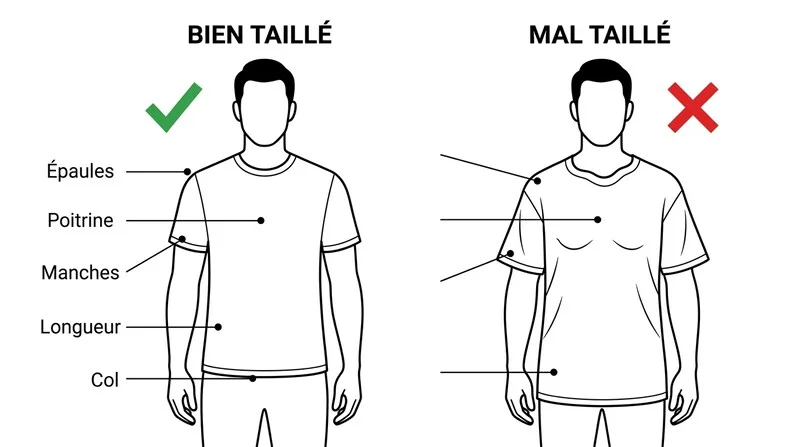
A well-cut t-shirt meets five checkpoints. The shoulder seam sits on the shoulder bone, the chest keeps 3 to 5 cm of ease and the sleeves end at mid-bicep without gripping it. The length covers the belt without going past the middle of the fly, and the neckline lies flat against the base of the neck. If just one of these points is off, the garment looks either too big or too tight.
- Shoulders: the seam falls on the curve of the shoulder. Any lower and it is one size too big (unless it is a deliberate oversized cut). Any higher and the fabric pulls towards the neckline.
- Chest and torso: pinch the fabric at the side. You should be able to grab 3 to 5 cm in a regular fit, 2 to 3 cm in a slim fit. Horizontal creases pulling towards the armpits mean the t-shirt is too tight.
- Sleeves: they skim the arm with a finger's width of room. A sleeve that flares like a bell widens the silhouette; a sleeve that clings to the arm looks like sportswear.
- Length: with your arms raised, the hem should not expose your stomach. With your arms by your sides, it stops between the belt and the middle of the fly.
- Neckline: it hugs the base of the neck without constricting it. A neckline that already gapes when you buy it will not get any better.
Taking your measurements to choose the right size
Measure your chest just under the armpits, with the tape horizontal and without puffing out your chest. Then compare it with a t-shirt you already like: lay it flat, measure the width from one armpit to the other and multiply by two. The difference between the two figures gives you the ease that suits you, far more reliable than an S, M or L, which varies from one brand to another.
The sales staff in our shops see it every day in the changing room: the number one mistake is still choosing the wrong size. Too big ‘to be comfortable’, or too tight ‘to look athletic’. At Jerem, alterations are done in store (they are charged for), but jersey is harder to alter than a shirt. It is better to spend five minutes trying on two sizes side by side before choosing.
The different types of men's t-shirt: necklines and cuts
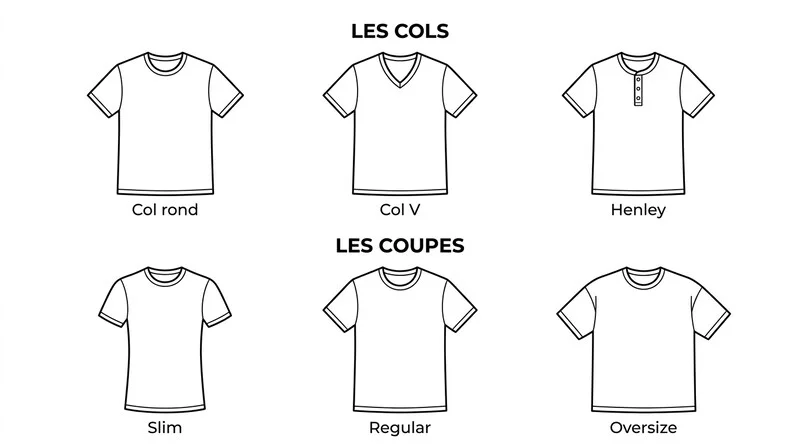
Two variables change everything on a t-shirt: the shape of the neckline and the cut of the body. The crew neck remains the most versatile, the V-neck lengthens the neck and the henley adds a dressier detail. As for the cut, fitted, regular and oversized are not meant for the same builds or the same occasions.
Crew neck, V-neck, henley
The crew neck is the foundation. It can be worn on its own, under a jacket or under an open shirt, and suits almost every body shape. The V-neck opens up the neck and flatters a round face or a short neck. Keep the point four fingers below the collarbone: any deeper and it starts to look like a nightclub outfit.
The henley, with its two- or three-button placket, sits between the t-shirt and the polo shirt. It smartens up a casual outfit. To go one step further, take a look at men's polo shirts.
Slim, regular, oversized
The slim fit follows the body closely, with a high armhole. It flatters slim to athletic builds and sits well under a jacket. The regular fit leaves a few centimetres of room: it is the easiest cut, the one we recommend for a first purchase.
The oversized fit deliberately extends the shoulders and widens the body. It works when it is intentional, with dropped shoulders and a controlled length. It fails as soon as it is just a classic t-shirt bought two sizes up. At Jerem, the fits are called Slim, Classic and Straight, so you get the same drape from one piece to the next. Our fit and style selection groups the styles by silhouette.
Which cut to choose for your body shape
The right cut depends less on your size than on the ratio between your shoulders and your waist. Broad shoulders are shown off by a close-fitting cut, while a stomach is played down by a regular fit and the right length. Here are the guidelines for each body shape.
- V (broad shoulders, narrow waist): fitted cut, crew neck. Avoid loose volumes that hide the waist.
- H (shoulders and hips in line): regular fit, V-neck to create verticality. A plain colour avoids adding width.
- O (prominent stomach): straight or classic cut, in a fabric of 180 g/m² or more that does not cling. Length to the middle of the fly, dark colours, nothing figure-hugging.
- A (hips wider than the shoulders): fitted sleeves and a crew neck to broaden the upper body. The hem should not stop right on the hips.
- X (balanced silhouette): every cut works, including a well-judged oversized fit.
Tall, slim men are better off avoiding a fitted cut that is too long, as it stretches the silhouette. Shorter men should watch the length above all: 2 cm too much is enough to make the legs look shorter.
Recognising a quality t-shirt: fabric, neckline and seams
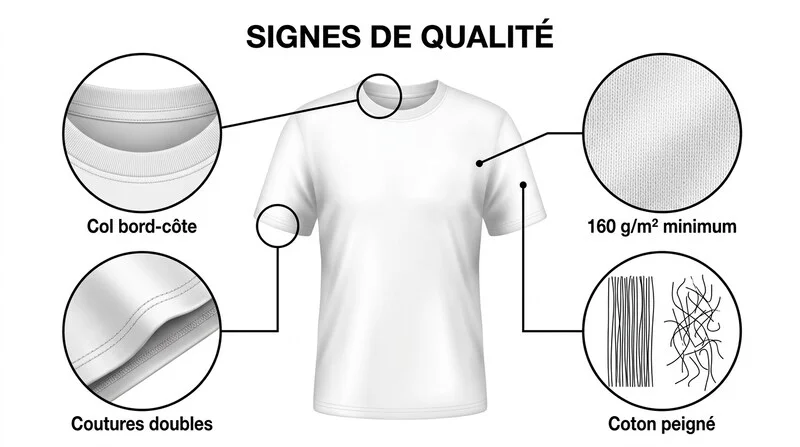
You can recognise a quality t-shirt in thirty seconds. Look for long-staple combed cotton, a fabric weight of at least 160 g/m², a dense rib-knit neckline and double stitching at the shoulders and hem. Price alone tells you nothing. These four points, on the other hand, signal a garment that will last dozens of washes, and they help you choose without making a mistake.
Jersey, fabric weight and yarn
Almost all t-shirts are knitted in jersey, a fine, supple knit. Single jersey, at around 140 to 160 g/m², is light and breathable, ideal in summer but more see-through in white. Heavyweight jersey, from 200 to 240 g/m², holds its shape better and disguises the torso's imperfections.
Look at the yarn too. Combed cotton has had its short fibres removed: it pills less and stays softer than carded cotton. Long fibres (Pima cotton, Egyptian cotton) give a smoother feel.
The neckline and the seams
Pull gently on the neckline: a quality rib knit springs straight back into place. A set-in collar with a neck tape sewn along the back of the neckline holds up better than a collar that is simply topstitched. Then examine the seams: tight, even stitches, double stitching on the hem and sleeves, and reinforcing tape at the shoulder.
One last test: lay the t-shirt flat. If the side seam is already twisting towards the front, the fabric was cut off-grain and the flaw will get worse in the wash.
The label must state the exact fibre composition, an obligation highlighted by the DGCCRF, the French consumer protection authority. Be wary of vague wording such as ‘cotton blend’ with no percentage.
Which fabric to choose for the climate and activity
Cotton remains the best choice for everyday wear in a temperate climate. Linen comes into its own when it is hot and dry. Merino wool is for travel and the in-between seasons, and elastane blends for comfort on the move. The table below helps you choose by combining use, temperature, fabric and weight.
| Use | Temperature | Fabric | Fabric weight | Recommended fit |
|---|---|---|---|---|
| Office, under a jacket | 15 to 22 °C | Combed cotton | 160 to 180 g/m² | Fitted or classic |
| Weekend, summer | Above 25 °C | Linen or cotton-linen | 140 to 160 g/m² | Classic or straight |
| Travel, in-between seasons | 10 to 20 °C | Merino wool | 150 to 190 g/m² | Classic |
| Layering under a jumper | Below 12 °C | Heavyweight cotton | 200 g/m² and above | Fitted |
| Active day, getting about | Variable | Cotton and elastane | 170 to 190 g/m² | Fitted or classic |
Linen creases, which is part of its charm, but it needs a looser cut to breathe. Merino wool regulates temperature and absorbs odours: a merino t-shirt can be worn for two or three days before washing. To compare the fibres in our collections, see the fabrics and comfort selection.
Wearing a t-shirt well: on its own, under a jacket or a shirt
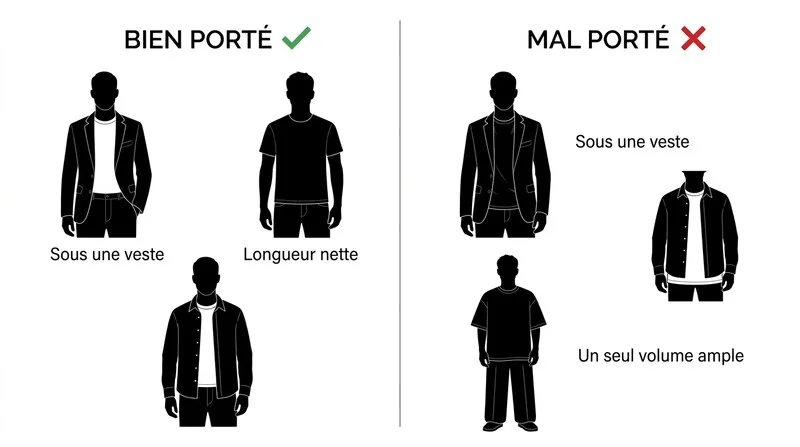
A well-worn t-shirt has a clean length, a neat neckline and colours that match the rest of the outfit. On its own with men's jeans, it needs a flawless cut, since nothing hides the way it falls. Under a jacket, it should be more fitted and thinner so that it does not create creases.
- Under a jacket: crew neck, fitted cut, plain colour (white, navy, grey marl). A casual men's jacket over a white t-shirt is the safest smart casual outfit there is.
- Under an open shirt: the t-shirt underneath should be shorter than the shirt. The logic of volumes is the same as with an oversized shirt: only one loose garment at a time.
- Tucked in or not: a t-shirt is worn untucked, except under a suit or with high-waisted trousers. Tucked into jeans, it looks dated.
- Colours: white, black, navy, grey and beige cover 90% of outfits. Save patterns and logos for the weekend.
The most common mistakes? A sports t-shirt under a blazer, or a V-neck that shows a vest underneath. Add to that rolled-up sleeves on fabric that is too thin, and a loose t-shirt with wide-leg trousers, which swamps the silhouette. To dress up further, our men's suit guide explains how to pair a casual top with a smart city outfit.
Care and cost per wear: what a t-shirt is really worth
The real price of a t-shirt is its cost per wear, not its price tag. A €15 t-shirt that loses its shape after 20 wears works out at €0.75 per wear. A €45 t-shirt that lasts 100 wears works out at €0.45. The second is cheaper in use, provided you look after it properly.
Washing without shrinking
Cotton shrinks mainly in the first wash and in the tumble dryer. Wash at 30 °C, inside out, with similar colours, and spin at 800 rpm maximum. Dry flat or on a wide hanger, never pegged up by the shoulders.
Care varies by fabric. Wash whites separately to stop them turning grey. Linen can take 40 °C but should be ironed damp, and merino wool goes on a cold wool cycle. Regular care also limits pilling under the arms, where the garment rubs the most.
Our advice for building your wardrobe
Rather than ten average t-shirts, choose five quality pieces in a cut that really suits you. Two white, one navy, one grey marl, one black. Buying less but better lowers the cost per wear and makes getting dressed in the morning simpler. Browse our men's tops online. You can also try the Slim, Classic and Straight fits in one of our shops, where the sales staff will help you find the right size.